If your salt chlorine generator was installed during the 2020-2021 chlorine shortage — and thousands in our area were — it's now living on borrowed time. Here's what we're seeing on routes across Coastal Georgia every week, and the decision every salt pool owner needs to make this season.
Salt cells wear out faster than most owners think
A salt cell is rated for roughly 8,000-10,000 operating hours, which works out to 3-5 years for a typical residential pool. Here in the coastal South, our swim season runs 8-9 months and cells run far more hours per year than the national average — so most local cells land at the early end of that range, often 3-4 years.
Here's the part that catches people off guard: a cell doesn't just die one day. The precious-metal coating on its plates wears away gradually, so a 3-4 year old cell can look "on" and still only produce a fraction of the chlorine it did when new. The generating light is lit, the salinity is fine — and the pool is slowly falling behind.
How old is your cell? Check the serial number
- Hayward (TurboCell/AquaRite): On most serials, digits 5-6 are the year and 7-8 are the month. Example: 21121911xxxx = built November 2019.
- Pentair (IntelliChlor): The label includes a date code — a five-digit block where the first three digits are the day of the year (001-365) and the last two are the year. Example: 15521 = day 155 of 2021 (early June 2021).
- Jandy (AquaPure/TruClear): The serial itself doesn't spell out a date — look for the small date dial or date sticker on the cell label, or call the manufacturer with the serial.
Can't find it or not sure? Bring us the serial or snap a photo — we'll date it for you.
Warning: counterfeit and knockoff salt cells are everywhere online
That "$499 genuine cell" on a marketplace listing is often used, relabeled, aftermarket, or outright counterfeit. Customers find out the hard way: the cell won't calibrate with their system, readings are wrong, unions leak, it fails in a season — and there's no valid warranty, because manufacturers only honor warranties on cells sold through authorized dealers (and the best coverage typically requires professional installation). If the price looks too good to be true, it is.
Why replacement costs so much more than it used to
Salt cell plates are coated with ruthenium and iridium — two of the scarcest precious metals on earth. Since early 2020, ruthenium is up roughly 6x and iridium over 4x, driven by tight supply and new demand from data centers and electronics. That's why a cell that cost $500-700 a few years ago now runs $1,100-1,800 installed, with prices still climbing.
The decision: replace the cell, or switch to a tab feeder?
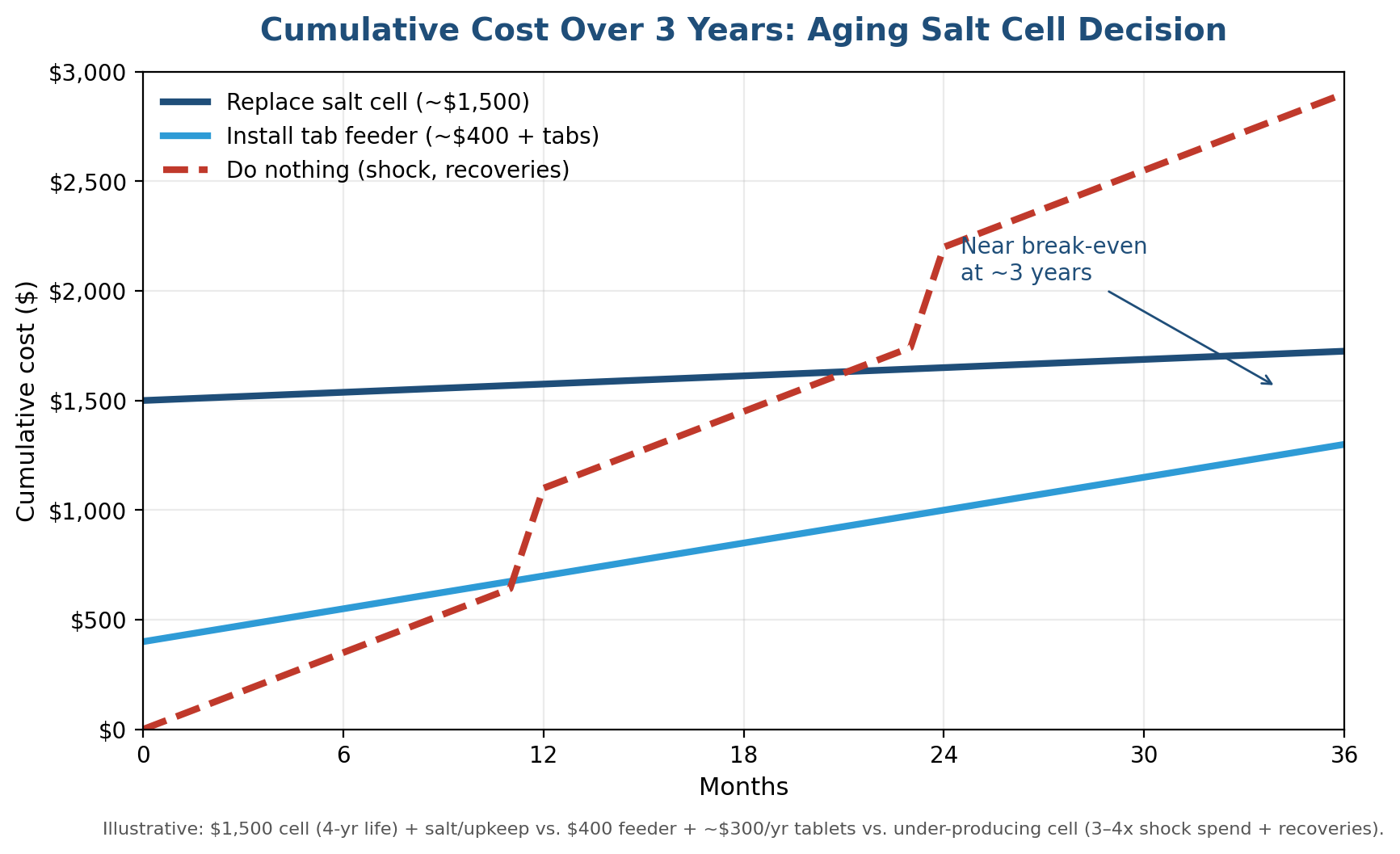
Chlorine tablet prices have stabilized since the shortage years. That changes the math. Over a typical cell's life, the two paths now come out close to break-even:
| Replace salt cell | Install tab feeder | Do nothing (weak cell) | |
|---|---|---|---|
| Upfront cost | ~$1,500 installed | ~$400 installed | $0 |
| Annual chemical cost | Salt + minor balancing (~$50-100/yr) | ~$300/yr (bulk 50-lb buckets) | $500-900+/yr in shock & recovery chems |
| Expected life | ~4 years, then repeat | 10+ years; a few cheap, simple parts | — |
| Ongoing upkeep | Salinity checks, cell cleaning | Keep feeder stocked; watch CYA | Cloudy/green water, algae blooms |
| Hidden costs | Another ~$1,500 in ~4 years | CYA buildup if not managed | Staining, degraded surface, lost swim time |
| ~3-year total | ~$1,300-1,500 | ~$1,300-1,400 | $1,500-2,700+ and a worse pool |
The worst option is the one we see most often: doing nothing. Owners with an underproducing cell end up spending 3-4x more on shock trying to keep up, stress or stain their pool surface, and lose weeks of swim time to cloudy or green water. If your cell is 3+ years old and the pool is a struggle, the cell is the first suspect.
"But I love my salt pool" — two things most owners don't know
- Salt pools ARE chlorine pools. The generator simply converts dissolved salt into chlorine. You were never swimming in a chlorine-free pool.
- You can keep the silky "salt feel" with a tab feeder. Just keep salt in the water at the same level as before. Salt doesn't evaporate — the feel stays, the feeder handles sanitizing.
One thing to manage with tablets: CYA (stabilizer)
Chlorine tabs contain cyanuric acid (CYA). Some CYA protects chlorine from sunlight, but as it accumulates it makes chlorine less effective and can cloud the water. Managing it is simple:
- Sand filter? Regular backwashing and pumping to waste keeps CYA in check — this is why we recommend sand filters for tab-fed pools.
- Cartridge filter? A waste bypass line can be added to do the same job.
- Periodically drain down a portion of the pool and refill, and lean on liquid chlorine (which adds zero CYA) during peak demand.
Our recommendation for heavy-demand pools
Even if you keep your salt system, every salt pool with heavy chlorine demand should have a tab feeder as a supplemental backup. During July-August in coastal Georgia, most cells can't keep up alone — a feeder bridges the gap for a few hundred dollars and saves you from emergency shock treatments.
Key takeaways
- Salt cells last ~8,000-10,000 hours — about 3-5 years, and often just 3-4 in our long coastal season.
- A cell that's 3+ years old can appear to work while producing far less chlorine than your pool needs.
- Check your cell's age with the serial number — or bring it to us and we'll date it in minutes.
- Avoid online marketplace cells — counterfeits and gray-market cells rarely integrate properly and carry no real warranty.
- Replacement cells cost roughly 2x what they did pre-2020 because ruthenium and iridium prices have exploded.
- Tablet prices have stabilized: over 3 years, replacing the cell ($1,500) vs. installing a tab feeder ($400 + tabs) is now nearly break-even.
- If you go with tabs, manage CYA: sand filter backwash/waste line, periodic drain-downs, and liquid chlorine in peak season.
- The most expensive choice is ignoring a weak cell — 3-4x more on shock, a damaged surface, and a pool you can't swim in.
Not sure what your cell is producing? We'll test output, date your cell, and give you a straight recommendation — replace, supplement, or convert. Contact Jeff's Pool & Spa Service (Brunswick 912-554-0636 · St. Marys 912-576-3636) or Perfect Pools (Savannah/Richmond Hill 912-459-0160).